

Forget what you think you know about property investing. The real money isn’t just in rent checks and appreciation—it’s in the massive real estate investment tax benefits that let you legally chop down your tax bill. This is the government-sanctioned playbook for turning the tax code into your personal wealth-building machine.
Your Playbook for Winning the Real Estate Tax Game
Beyond the thrill of closing a deal, the smartest investors master a different game entirely—one played on tax forms, not just in the market. Real estate is a special kind of asset, and the IRS gives you a whole suite of advantages designed to encourage you to own it. This isn’t about finding sketchy loopholes; it’s about knowing the rules and using the strategic tools the tax code provides.
This guide is your roadmap. We’re cutting out the dry, academic nonsense and giving you an investor’s playbook. We’ll break down the core concepts that separate the amateur landlords from the savvy wealth-builders. The focus here is on real-world insights that turn your tax burden into a strategic advantage.
We’ll cover the essentials every investor must know:
- Depreciation: Learn how to claim a “paper loss” on your property that puts real cash back in your pocket, even while your asset is gaining value.
- Deductions: Find out how to turn everyday operating costs—from repairs to property management fees—into serious write-offs that lower your taxable income.
- Tax-Deferred Exchanges: Unlock the power of the 1031 exchange to roll profits from one property into the next without handing a chunk of it over to the IRS right away.
The goal is simple: keep more of your own money. By the time you’re done here, you’ll see your investment properties not just as income streams, but as powerful engines for building long-term, tax-efficient wealth.
Whether you’re buying your first rental in Los Angeles or scaling a portfolio across state lines, mastering these tax benefits is absolutely non-negotiable for maxing out your returns. Let’s get into it and see how you can stop seeing taxes as a problem and start using them as a tool.
How Depreciation Slashes Your Taxable Income
If there’s one undisputed heavyweight champion among real estate tax benefits, it’s depreciation. This is the ultimate tax shield—a powerful “paper loss” that generates very real cash savings year after year.
Here’s the brilliant part: the IRS essentially gives you a gift. It lets you deduct a portion of your property’s value each year, even while the property itself is likely going up in value.
Think of it this way: the tax code assumes your building is slowly wearing out. It lets you write off that theoretical wear and tear as a business expense. This non-cash deduction directly attacks your taxable rental income, shrinking your tax bill and leaving more money in your pocket where it belongs.
This isn’t some obscure loophole; it’s a cornerstone of smart real estate investing. Even as global commercial property valuations dipped by about 6.3% year-over-year through mid-2024, the ability to claim depreciation helped investors shelter their rental income. It’s a critical buffer, especially in a shaky market.
The Mechanics of Depreciation
The process is more straightforward than it sounds. The IRS simply sets a “useful life” for different property types, which tells you how long you get to claim the deduction.
- Residential Rental Property: You depreciate the building’s value over 27.5 years.
- Commercial Property: The schedule is a bit longer, stretching to 39 years.
Now, there’s one critical rule: you can only depreciate the building itself, not the land it sits on. In the eyes of the taxman, land doesn’t wear out. So, your first step is always to separate the value of the land from the value of the structure.
This infographic breaks down how that annual deduction steadily chips away at your tax burden.
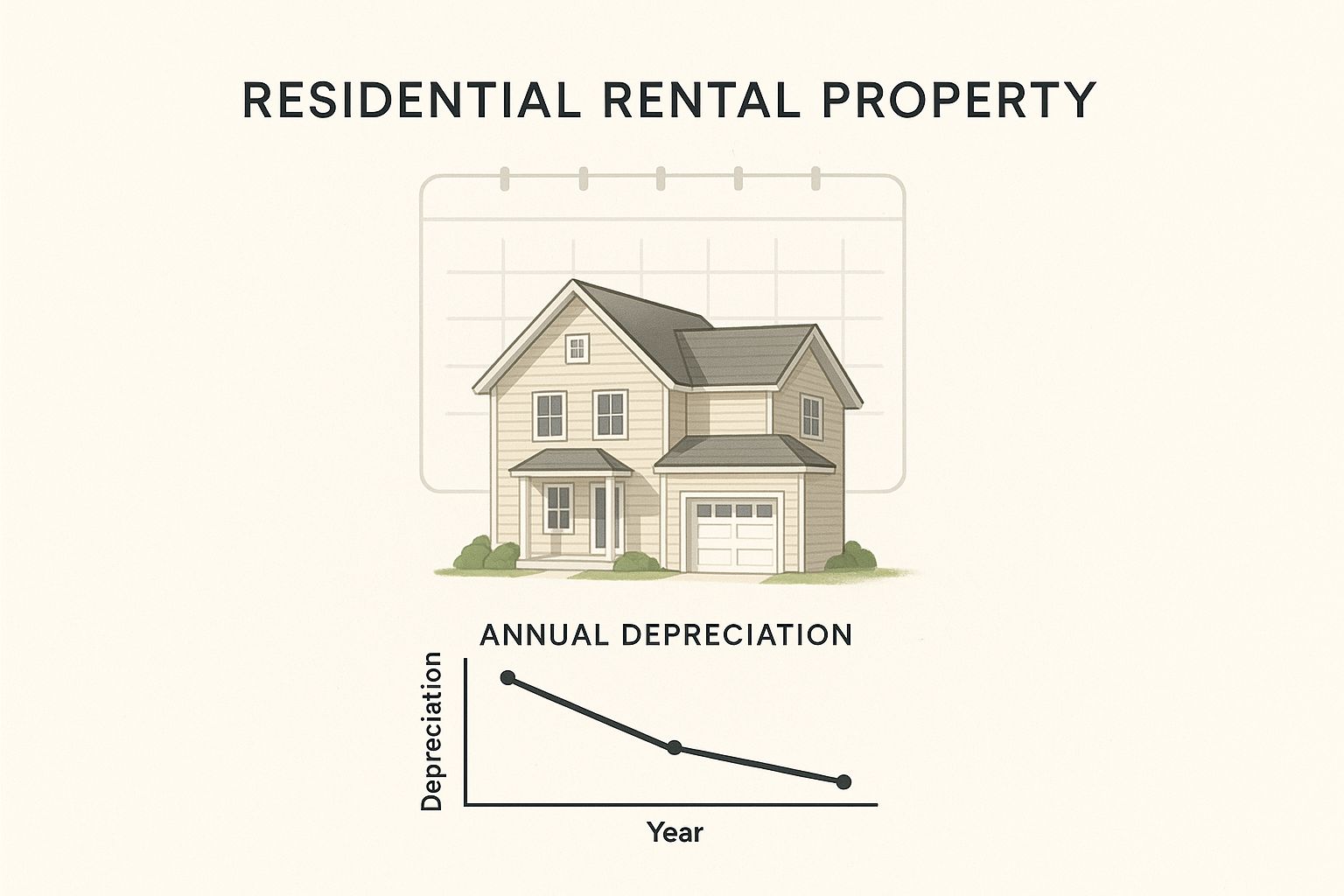
As you can see, depreciation isn’t a one-time trick. It’s a consistent, methodical benefit that works for you every single year you own the property.
Let’s put some real numbers to this. Say you buy a residential rental for $500,000. After an appraisal, you determine the land is worth $100,000, leaving a $400,000 value for the building. That $400,000 is your “depreciable basis.”
Calculation Breakdown:
- Depreciable Basis: $400,000
- Useful Life: 27.5 years
- Annual Depreciation Deduction: $400,000 / 27.5 = $14,545
That’s $14,545 you get to deduct from your rental income every year, lowering your tax liability without spending a single extra dollar out of pocket.
This table shows the stark difference depreciation makes on your bottom line. It turns a profitable year into a “loss” on paper, which is exactly what you want for tax purposes.
Depreciation Impact on Annual Taxable Income
| Financial Item | Without Depreciation | With Depreciation |
|---|---|---|
| Annual Rental Income | $30,000 | $30,000 |
| Operating Expenses | -$12,000 | -$12,000 |
| Net Operating Income | $18,000 | $18,000 |
| Depreciation Deduction | $0 | -$14,545 |
| Taxable Income (or Loss) | $18,000 | $3,455 |
See the magic? Your actual cash profit is $18,000, but thanks to depreciation, you’re only paying taxes on $3,455 of it. This is how savvy investors build wealth.
To get the most out of this, check out a practical guide on how to calculate depreciation for your own properties. You can also run the numbers with our guide to mastering your real estate investment calculator to see the impact on your specific deals.
Supercharge Your Savings With Cost Segregation
Ready to level up? For serious investors, there’s an advanced strategy called a cost segregation study. This isn’t a DIY job; it involves hiring specialized engineers to perform a deep dive on your property’s components.
Their goal is to identify parts of the building that can be depreciated much faster than the standard 27.5 or 39 years.
We’re talking about things like:
- Fixtures and Appliances: Often depreciated over just 5 or 7 years.
- Flooring and Carpeting: Also qualify for accelerated schedules.
- Landscaping and Pavement: These exterior elements have shorter useful lives, too.
By reclassifying these assets, a cost segregation study “front-loads” your depreciation deductions into the first few years of ownership. This can create massive tax savings right away, freeing up a ton of cash flow that you can pour back into your next deal.
It’s a pro-level move that turns a great tax benefit into an absolutely exceptional one.
Your Ultimate Checklist of Property Deductions
If depreciation is the heavyweight champion of tax benefits, then deductions are the quick, agile jabs that win you the fight round by round. You need to start thinking of your investment property as a small business—because that’s exactly how the IRS sees it. This mental shift is everything. It opens the door to a powerful truth: nearly every dollar you spend running and maintaining that property can be a write-off.
These deductions are your secret weapon against a big tax bill. They chip away at your rental income, systematically shrinking your taxable profit. Every legitimate expense you track lands a direct hit on your tax liability, turning your operating costs into serious savings. It’s not about spending more; it’s about being obsessed with tracking what you already spend.

This goes way beyond the obvious stuff. Sure, mortgage interest and property taxes are the headliners, but the real money is saved in the long list of supporting acts. Meticulous record-keeping is your ticket to maximizing every single one of these tax benefits.
The Big Four Core Deductions
Let’s start with the non-negotiables—the foundational deductions almost every single real estate investor will claim. These are the predictable, recurring costs of doing business in this game.
- Mortgage Interest: That huge chunk of your monthly payment going straight to the bank? On an investment property, it’s almost entirely deductible. For most investors, this will be the single largest deduction you take all year.
- Property Taxes: Your annual payment to the local government is another massive write-off. You have to stay on top of local tax laws, especially if you’re investing in high-tax areas. For a deeper look, our guide on property taxes in Los Angeles is a must-read for California investors.
- Insurance Premiums: Landlord insurance, flood insurance, liability insurance—it’s all deductible. The money you spend to protect your asset directly lowers your tax bill. It’s a win-win.
- Operating Expenses: This is a broad category, but it’s incredibly powerful. It covers everything from utilities (if you’re paying them for tenants) and HOA fees to landscaping and pest control. If it keeps the property running, it’s likely a write-off.
Everyday Expenses That Add Up
Beyond those big four, a whole host of smaller, day-to-day costs can combine to create a huge deduction. Don’t ever overlook these. They add up faster than you think.
- Professional and Legal Fees: Paid an accountant to handle your taxes? Hired a lawyer to draft a lease? Those fees are business expenses, plain and simple. Deduct them.
- Property Management Fees: If you hire a pro to manage your property, their entire fee—which is typically 8-12% of the monthly rent—is a write-off.
- Advertising Costs: The money you spent on Zillow listings, Facebook ads, or even just a “For Rent” sign in the yard is fully deductible. Remember to focus your ads on the property’s features, not on the type of tenants you’re looking for, to stay aligned with Fair Housing laws.
- Travel Expenses: Did you drive to your property to show it to a new tenant or meet a plumber? You can deduct the mileage. Just make sure you keep a detailed log. A simple app can handle this.
To make sure you don’t miss a single thing, you need a solid system for streamlining invoice management for your real estate investments. A clean system stops you from leaving money on the table come tax time.
Repairs Versus Improvements: The Critical Difference
This is where so many new investors get tripped up. The IRS draws a hard, bright line between a “repair” and an “improvement,” and the difference has a dramatic impact on your taxes. You absolutely have to get this right.
A repair keeps the property in good operating condition. An improvement makes the property better, restores it, or adapts it to a new use.
Think of it this way: a repair is about maintenance, while an improvement is about upgrading.
| Expense Type | Definition | Tax Treatment | Example |
|---|---|---|---|
| Repair | Maintains the property’s current condition | Deductible in the current year | Fixing a leaky faucet, patching a hole in the wall |
| Improvement | Adds value or extends the property’s life | Must be depreciated over time | Installing a new HVAC system, replacing the roof |
Why is this so important? Because a $500 repair for a broken window reduces your taxable income by $500 this year. But a $15,000 roof replacement (an improvement) has to be depreciated over 27.5 years. That means you only get a deduction of about $545 this year. Both give you a tax benefit, but the timing is completely different. Nailing this distinction is essential for smart tax planning.
Using a 1031 Exchange to Defer Capital Gains
Of all the tax breaks available to real estate investors, the 1031 exchange is probably the most powerful wealth-building tool in the entire tax code. It’s the ultimate cheat code. It lets you sell an investment property and roll every single penny of the proceeds—profit included—into a new, better property while legally hitting pause on your tax bill.
This isn’t about tax evasion; it’s about tax deferral. The whole point is to keep your capital working for you, compounding your returns without the IRS taking a 15-20% cut every time you trade up. Instead of forking over a huge chunk of your profits, you get to reinvest that money to acquire bigger and better assets.
The process is governed by some very strict rules, but they aren’t nearly as intimidating as they sound. For any serious investor looking to scale, mastering them is non-negotiable.
The Ground Rules of a 1031 Exchange
To pull this off, you have to play by the IRS’s playbook. There are a few key rules that make or break the whole deal. The two most important things to get right are the type of property you buy and the timeline you follow.
First, the properties have to be “like-kind.” This term is way more flexible than it sounds. It doesn’t mean you have to swap a duplex for another duplex. You can exchange raw land for an apartment building or an office space for a single-family rental. The only real requirement is that both the property you sell and the one you buy are held for investment or business purposes.
You can’t use a 1031 exchange on your personal home or a quick fix-and-flip. The IRS is clear: the property has to be used for business or held as an investment.
Second, the timeline is absolutely unforgiving. The moment you close the sale on your original property (the “relinquished” property), two clocks start ticking at the same time:
- The 45-Day Identification Period: You have exactly 45 calendar days to formally identify, in writing, the properties you might buy as a replacement.
- The 180-Day Closing Period: You must close on one or more of those identified properties within 180 calendar days from your original sale date.
These deadlines run together and are set in stone. Miss either one by a single day, and the whole exchange is disqualified. Hello, massive tax bill.
The Role of the Qualified Intermediary
Here’s a critical detail: you can’t just sell your property, pocket the cash, and then go buy a new one. To keep the tax-deferred status, the money from the sale has to be handled by a neutral third party called a Qualified Intermediary (QI). This isn’t optional; it’s mandatory.
The QI’s job is simple but crucial. They hold your funds in escrow after the sale and then use that cash to buy the replacement property for you. This structure ensures you never have “constructive receipt” of the money, which would kill the deal and trigger taxes immediately. Picking a reputable QI is one of the most important moves you’ll make.
Let’s look at a quick example to see why this is so powerful.
- Scenario: You sell a rental property and walk away with a $200,000 capital gain.
- Without a 1031 Exchange: You’d owe somewhere around $40,000 in federal and state capital gains taxes. That leaves you with only $160,000 to put into your next deal.
- With a 1031 Exchange: You get to reinvest the entire $200,000 into a new, larger property. That extra $40,000 keeps growing and appreciating, putting your portfolio’s growth on steroids.
For a comprehensive guide on leveraging this powerful tool, consider learning more about the 1031 Exchange.
Advanced Tax Strategies for Serious Investors
You’ve gotten the hang of depreciation and deductions. The idea of a 1031 exchange doesn’t make you break out in a cold sweat anymore. Great. Now it’s time to stop just playing the game and start writing the rules in your favor.
This is where we get into next-level tax planning. We’re talking about sophisticated strategies that don’t just protect what you’ve built, but actively grow it. These are the moves that separate the pros from the pack and pave the way for serious, long-term wealth.

Unlocking the Qualified Business Income Deduction
One of the most powerful—and surprisingly overlooked—tools in an investor’s arsenal is the Qualified Business Income (QBI) deduction. You might also see it called Section 199A. Think of it as a massive thank-you bonus from the IRS for running your rentals like an actual business.
If you qualify, you can deduct up to 20% of your net rental income. That’s a direct hit against your taxable income without spending a single extra dime. For investors pulling in a decent income, this is a game-changer that can translate to thousands in tax savings every year.
So, how do you get in on this? The IRS is clear: your rental activities have to rise to the level of a “trade or business.” That’s not a fuzzy suggestion; you have to prove it.
Here’s what that looks like on the ground:
- Serious Time Commitment: You (or your team) are spending substantial, regular time on the properties. The IRS offers a safe harbor guideline of at least 250 hours per year.
- Pristine Record-Keeping: You must maintain separate books and records for your rentals, proving you’re treating them like a legitimate enterprise.
- Active Management: This isn’t just cashing checks. It’s everything from negotiating leases and screening tenants to coordinating repairs and managing the books.
This isn’t for the passive, set-it-and-forget-it landlord. It’s for active investors who are serious about their operations.
Shielding Your Assets with an LLC
As your portfolio grows, so does your exposure to risk. Holding properties in your personal name is like playing Russian roulette with your finances. One slip-and-fall lawsuit on a property could jeopardize your personal home, your car, and your savings.
This is where a Limited Liability Company (LLC) becomes your fortress. By setting up an LLC and transferring your properties into it, you create a legal firewall between your business assets and your personal life. If something goes sideways at a rental, the lawsuit generally stops at the LLC’s door.
An LLC is more than just a legal shield; it’s a strategic business move. It provides liability protection while maintaining tax simplicity, offering the best of both worlds for many real estate investors.
The tax side of things is equally slick. For tax purposes, a single-member LLC is typically a “disregarded entity.” This just means all the income and expenses flow right onto your personal tax return (Schedule E), exactly as if you owned it personally. You get heavy-duty legal protection without the headache of complex corporate tax filings.
This blend of asset protection and tax efficiency makes forming an LLC a non-negotiable step for any investor looking to scale their portfolio responsibly. Understanding the nuances between different property types, from hotels to single-family rentals, will also sharpen your strategy. If you want to dive deeper, you can explore our analysis on different real estate investment types.
Common Questions on Real Estate Tax Benefits
The world of real estate tax benefits can feel like a maze. Once you get past the big-picture strategies, it’s the day-to-day questions that trip up most investors.
Think of this section as your rapid-fire Q&A. I’m tackling the most common head-scratchers to give you the clear, actionable answers you need to invest with confidence. Let’s dive into the practical scenarios that pop up when you’re in the trenches.
Can I Deduct Losses From My Rental Property?
Absolutely, but the IRS has some important rules you need to know. When your rental property’s expenses are more than its income for the year, you’ve got a “passive activity loss.” For most people, you can’t just use that loss to wipe out the taxes on your day job salary.
But there’s a huge exception. If your modified adjusted gross income is under $100,000, you can usually deduct up to $25,000 in those rental losses against your other income. That’s a massive win. This benefit starts to phase out and disappears completely once your income hits $150,000.
There’s also a pro-level move for those who qualify as a “real estate professional” in the eyes of the IRS. This status unlocks the ability to deduct unlimited rental losses, making it an incredibly powerful tool for serious, full-time investors.
What’s the Difference Between a Repair and an Improvement?
This is one of the most critical distinctions in real estate tax law, and getting it wrong can cost you big time.
A repair is just what it sounds like—an expense that keeps your property in good working condition. Think of it as basic maintenance. Fixing a leaky pipe, patching drywall, or replacing a single broken window pane are all classic repairs. The best part? These costs are 100% deductible in the year you pay for them.
An improvement, on the other hand, adds real value to the property, extends its life, or adapts it for a new use. We’re talking about big-ticket items like replacing the entire roof, installing a new central AC system, or gut-remodeling the kitchen. You can’t deduct these costs all at once. Instead, you have to capitalize and depreciate them over 27.5 years.
Do I Have to Pay Taxes When I Sell a Rental Property?
Yes, when you sell an investment property for a profit, Uncle Sam will want his cut. You’ll generally face two different types of tax on your gain.
First up is the capital gains tax on the property’s appreciation—the difference between what you bought it for and what you sold it for. If you held the property for more than a year, you get to pay the much lower long-term capital gains rate, which is a huge advantage.
Second is something called depreciation recapture. The IRS basically wants back some of the tax breaks you got from depreciation over the years. This slice of your gain gets taxed at a maximum rate of 25%. This is exactly why savvy investors use strategies like the 1031 exchange to legally defer both of these taxes and keep their capital working for them.
Ready to turn these tax strategies into a reality in the Los Angeles market? The team at ACME Real Estate has the local expertise and investment insight to guide you. Contact us today to start building your wealth-generating portfolio.