
Alright, let’s cut to the chase. Choosing a home inspector isn’t just another box to tick in the home-buying marathon. You’re hiring a property detective—a professional skeptic whose job is to uncover a house’s dirty little secrets before you ink a deal that could define your financial future. A top-notch inspector is your best defense against a financial nightmare cleverly disguised as your dream home.
Why Your Home Inspector is Your Most Important Hire

Think of the inspector as your personal risk assessor for what’s likely the biggest purchase you’ll ever make. Your real estate agent is your sherpa for finding and negotiating the deal, but the inspector’s sole mission is to deliver an unbiased, brutally honest evaluation of the home’s condition.
Their report is pure leverage. It’s the tool that lets you negotiate repairs, demand seller credits, or, when necessary, bail on a money pit without a second thought.
Picking the right person for this job demands the same diligence you’d use for any critical hire. This is your investment on the line. As one guide to hiring a reliable service agency points out, the principles of vetting a professional are universal. Your search for an inspector should be just as meticulous.
Referrals Are Just the Starting Point
Getting a recommendation from your agent is a solid first move. Agents are in the trenches daily and know who’s reliable and who’s not. But don’t just take their word for it and call it a day. This is your money and your future home; the final decision has to be yours.
A recent survey revealed that while 14% of buyers get recommendations from friends or family, a staggering 86% of all inspections uncover at least one problem. This underscores why an objective, third-party expert is non-negotiable.
What kind of problems are we talking about? The usual suspects are roofing defects (20%), electrical gremlins (18%), and window issues (18%). Even more alarming, 10% of inspections were arranged by the seller—a massive red flag for potential bias.
This data is precisely why you need to do your own independent vetting. You need to find someone whose only loyalty is to you. They work for you, and their job is to deliver the unvarnished truth about the property so you can proceed with your eyes wide open.
Home Inspector Vetting Checklist
Use this table as your battle plan when you’re interviewing potential inspectors. It covers the essentials to ensure you’re hiring a true pro who has your back.
| Vetting Area | What to Look For | Why It Matters |
|---|---|---|
| Certifications & Licensing | State license (if required), certifications from InterNACHI or ASHI. | Confirms they meet industry standards for training and ethics. |
| Experience | At least 5 years of full-time experience and hundreds of inspections. | Experience builds pattern recognition; they’ve seen it all. |
| Insurance | Proof of both E&O (Errors & Omissions) and General Liability insurance. | Protects you if they miss something major or cause damage on-site. |
| Sample Reports | Detailed, photo-rich reports that are easy to understand. | Shows their communication style and the level of detail you’ll receive. |
| Client Reviews | Consistent positive feedback on Google, Yelp, or industry sites. | Real-world feedback is the best indicator of professionalism and quality. |
By checking these boxes, you’re not just hiring an inspector; you’re buying peace of mind. You’re ensuring the person walking through your potential home is qualified, insured, and committed to giving you the full picture.
Decoding Certifications and Local Experience

When you start looking for a home inspector, it can feel like you’re drowning in alphabet soup. You’ll see acronyms like ASHI and InterNACHI splashed across websites and business cards, but what do they actually mean for you?
Think of these as the baseline for professionalism. Organizations like the American Society of Home Inspectors (ASHI) and the International Association of Certified Home Inspectors (InterNACHI) aren’t just social clubs. They establish a national standard of practice and a code of ethics. Earning that stamp of approval means passing rigorous exams and committing to ongoing education.
It’s your first clue that an inspector isn’t just winging it.
What Those Letters Actually Get You
These certifications are an easy first filter. They separate the hobbyists from the dedicated pros pretty quickly. An inspector who invests time and money into these credentials is also investing in their own expertise, which directly benefits you.
Here’s the deal—these associations require their members to:
- Pass a comprehensive exam to prove they have the foundational knowledge.
- Follow a strict code of ethics, which is your shield against conflicts of interest.
- Complete annual continuing education to stay current on new building materials, common defects, and modern inspection techniques.
Choosing an inspector with these credentials gives you a crucial layer of confidence. You know they’re held accountable by a national organization, not just their own promises.
A certification shows an inspector has met a national standard. Local experience shows they can apply that knowledge where it matters most—the specific community you want to call home.
Why Local Experience Is the Ace Up Their Sleeve
A certificate is critical, but it’s only half the story. The real game-changer is an inspector’s deep, hands-on experience with the homes in your specific area.
An inspector who has spent years working in Los Angeles will spot things a newcomer simply won’t. They’ll recognize the subtle signs of foundation issues common to hillside homes in the Hollywood Hills or know exactly what to look for in the quirky plumbing of a mid-century home in the Valley. This kind of hyper-local knowledge is priceless.
The home inspection market is intensely localized. A recent analysis of over 33,000 inspection companies showed huge variations in competition from one city to the next. You can learn more about the competitive home inspection market and see for yourself why localized expertise is such a massive advantage.
This is why you have to dig deeper than just certifications. Ask them directly about their experience with:
- Neighborhood Nuances: Are they familiar with the common issues in Pasadena versus what pops up in Santa Monica?
- Home Age: Do they know the unique quirks of a 1920s craftsman versus a 1980s tract home?
- Specific Conditions: Do they understand the local soil conditions, common pests, or issues related to the coastal air?
An inspector with this ground-level intel can spot subtle clues that others might miss, potentially saving you from a world of financial pain down the road. Their local experience transforms a standard inspection into a truly insightful analysis of your potential home.
The Inspector Interview Questions You Must Ask
Think of this less like hiring a handyman and more like a job interview for a key player on your personal finance team. Because that’s exactly what this is. The right questions cut through the fluff and get straight to an inspector’s competence, attention to detail, and communication style.
This is your chance to vet them before they set foot on the property. A great inspector will be transparent and patient, viewing your questions as a sign that you’re a serious, diligent client. If they seem evasive, rushed, or annoyed? That’s your cue to hang up and move on.
Questions About Their Process and Experience
Start with questions that pull back the curtain on how they actually operate. You’re not just buying a PDF report; you’re buying their expert judgment, honed over years of crawling through dusty attics and damp crawl spaces.
Here’s what you need to ask:
- “How long does a typical inspection take for a house this size and age?” For an average-sized home, a thorough job should take at least 2-3 hours. If they quote 90 minutes, they’re likely doing a quick, superficial fly-by.
- “Do you encourage the buyer to attend the inspection?” The only acceptable answer is an enthusiastic “Yes!” Their role is to educate you about the home. An inspector who tries to keep you away is a massive red flag.
- “Can I see a recent sample report for a home similar to the one I’m buying?” This is non-negotiable. It’s the single best preview you’ll get of their work quality and how they communicate problems.
This is the initial filtering process, a way to weed out the pretenders before you even pick up the phone.
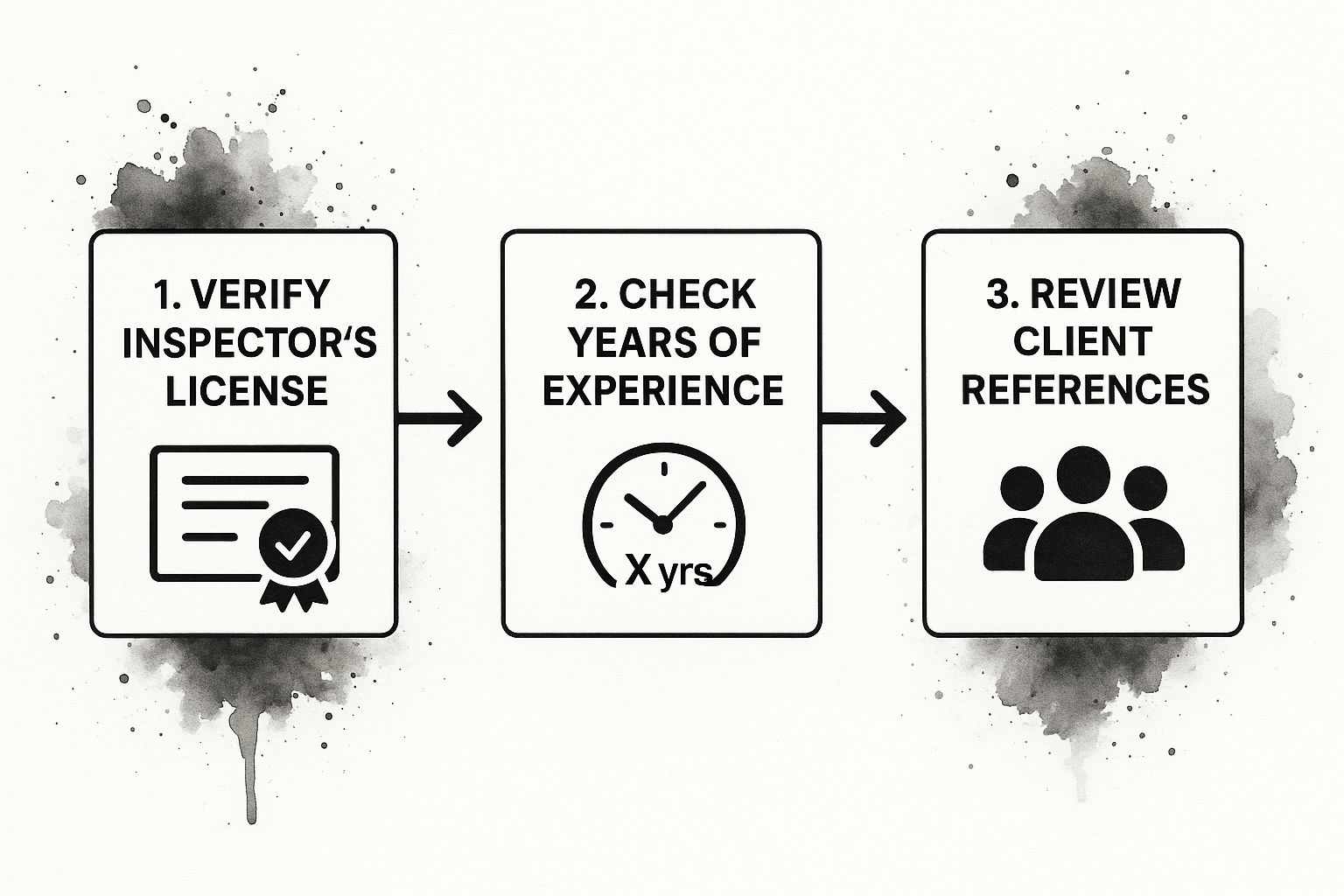
Running through these initial checks—confirming licenses, experience, and what others say about them—acts as a powerful first line of defense.
Questions About Protection and Liability
Now for the questions that protect your backside. This is all about accountability and ensuring you’re hiring a legitimate, insured professional. Don’t feel awkward asking these direct questions; any true pro will have the answers locked and loaded.
An inspector’s job is to find problems, but their insurance is your safety net in case they miss a big one. Never skip the insurance question.
Ask these point-blank to confirm they’re running a serious operation:
- “Do you carry both General Liability and Errors & Omissions (E&O) insurance?” General Liability covers accidents, like if they put a foot through a ceiling. But E&O insurance is what protects you if they make a critical mistake or overlook a major defect in their report. Both are essential.
- “What are your specific credentials and certifications?” You want to hear affiliations with major national organizations like ASHI or InterNACHI. It shows they’re committed to industry standards and not just some freelancer with a flashlight.
- “What tools do you use beyond the basics?” Experienced inspectors invest in their craft. They’ll often use tools like thermal imaging cameras to spot hidden moisture or insulation gaps, and moisture meters to quantify dampness instead of just guessing.
Their answers here tell you everything. A confident, detailed response signals a pro. A vague or defensive answer tells you to keep looking.
How to Read a Home Inspection Report

The inspection report is the grand finale. It’s the ultimate deliverable that reveals everything about the quality of the inspector’s work. Think of it as their final exam, their resume, and your personal home-buying bible all rolled into one.
A great report isn’t a generic, software-generated checklist. It’s a detailed, custom guide to the property you’re about to buy. It’s a narrative packed with high-resolution photos, clear explanations of any defects, and—most importantly—context about how serious each issue really is.
It’s the difference between a lazy note saying “roof issue” and a detailed entry with pictures showing cracked shingles, explaining the potential for leaks, and giving a realistic estimate of the roof’s remaining lifespan.
From Vague Checklist to Actionable Guide
Before you even think about hiring someone, you must review a sample report from them. Ask yourself: does this report help me distinguish between a minor cosmetic fix and a major structural red flag? A good report categorizes issues, usually with a summary section that highlights the most critical findings needing immediate attention.
This summary is your negotiation weapon. It’s the document you and your agent will use when you go back to the seller to discuss repairs or credits. If that summary is weak, vague, or confusing, your leverage evaporates. For a better sense of what should be covered, you can look over an ultimate building inspection checklist to see the level of detail required.
Technology is also playing a much bigger role in the quality of reports these days. Digital reports are now standard, but the best inspectors are also using tools like thermal imaging to find hidden moisture or insulation gaps. As buyers become more focused on long-term durability, you’re seeing a bigger emphasis on deep dives into structural integrity and energy efficiency.
What a High-Quality Report Includes
So, what separates a championship-level report from an amateur attempt? You’re not looking for a novel, but you do need clarity, not confusion.
Here are the non-negotiables:
- Detailed Narrative Descriptions: Every issue needs to be explained in plain English, not technical jargon. The report should describe the problem, explain why it’s a problem, and suggest the next steps (e.g., “consult a licensed plumber”).
- High-Resolution, Annotated Photos: A picture is worth a thousand words, especially when it has an arrow pointing directly at a hairline crack in the foundation. Photos provide undeniable proof and remove any ambiguity.
- Clear Severity Ratings: A great report makes it dead simple to tell the difference between urgent repairs, recommended upgrades, and routine maintenance items you can tackle later.
The best inspection report doesn’t just tell you what’s wrong; it educates you on how the home works. It becomes your user manual for future maintenance, helping you protect your investment long after you move in.
When you see a report loaded with this level of detail and context, you know you’re dealing with a true professional. It’s a core piece of your due diligence, and our guide on the real estate due diligence checklist shows you exactly how it fits into the bigger picture of a smart home purchase.
The Red Flags That Scream “Walk Away”
Knowing what to look for in a great home inspector is only half the battle. Knowing what to avoid is just as critical. Think of this as your field guide to spotting trouble before it costs you a fortune.
Some red flags are huge and obvious, like a billboard on fire. Others are more subtle. All of them are signs you need to keep looking.
One of the biggest, brightest, flashing red flags is a glaring conflict of interest. If an inspector offers to perform repairs for any issues they find on their report, you need to run—don’t walk—in the other direction.
Their entire job is to give you an unbiased, brutally honest assessment of the home’s condition. They can’t do that if they’re also trying to create a sales pitch for their side hustle. It’s an absolute ethical line a true professional will never, ever cross. Their loyalty should be to you and the truth, period.
The Problem with Bargain-Bin Inspectors
Everyone loves a good deal, but a home inspection is the absolute last place you should be bargain hunting. An inspector advertising a rock-bottom price, like $250 for a full inspection, should immediately make you suspicious.
Think about it. A thorough inspection takes several hours on-site, plus more time back at the office to write a detailed, comprehensive report. A suspiciously low price usually means one of two things:
- They’re rushing the job. They’ll be in and out in an hour, doing a quick surface-level scan that misses the critical, expensive problems hiding in the foundation, attic, or electrical system.
- They lack experience or proper tools. Veteran inspectors invest thousands in their education and equipment—things like thermal imaging cameras and moisture meters. Their pricing reflects that expertise.
That “bargain” inspection could easily become the single most expensive mistake you make in the home-buying process. You’ll be on the hook for thousands in repairs that a more thorough, professional inspector would have caught from a mile away.
A cheap inspection is never a good deal. It’s almost always just an expensive problem in disguise, leaving you to discover the real issues after you’ve already moved in.
Other Warning Signs You Can’t Ignore
Beyond shady pricing and conflicts of interest, there are other deal-breakers you need to watch for. Keep your senses sharp for anyone who seems to be cutting corners on their professional obligations.
A legitimate inspector should have zero problems providing you with proof of both General Liability and Errors & Omissions (E&O) insurance. Any hesitation to show you their policy documents is a massive sign they might not be covered, which puts all the risk squarely on your shoulders.
Another major red flag is any resistance to you attending the inspection. A great inspector wants you there. They see it as an opportunity to walk you through the property and educate you about your potential new home.
An inspector who discourages your presence might be worried you’ll see how fast they’re working or how little they’re actually checking. Be wary of anyone who prefers to work without an audience—it’s your investment, and you have every right to be there for every minute of it.
Common Questions About Home Inspections
Even with the best game plan, questions always come up when you’re in the thick of buying a home. And when it’s time to choose a home inspector, you’re definitely not alone in wondering about the details. Let’s tackle some of the most common questions buyers ask.
Should I Use My Agent’s Recommended Inspector?
This is a classic, and the answer isn’t a simple yes or no. A good agent has a shortlist of inspectors they trust—people who are thorough, reliable, and professional. Think of their recommendation as an excellent starting point.
But that list should be a launchpad, not the final destination. Ultimately, this is your decision. It’s on you to do the final round of vetting. Check their reviews, look at their sample reports, and run them through the interview questions we’ve covered. A great agent will respect and even encourage you to do your own homework.
How Much Should I Expect to Pay?
It’s tempting to shop for the lowest price, but a home inspection is one area where you absolutely get what you pay for. The cost depends on the property’s size, age, and location, but you can generally expect to pay between $300 and $600 for a standard inspection.
Think of it as an investment, not an expense. A more experienced inspector might charge a bit more, but their sharp eye could save you from a $15,000 roof replacement or a crumbling foundation that a cheaper, less thorough inspector might miss. Don’t let a hundred-dollar difference today cost you thousands tomorrow.
A home inspection is a snapshot in time. It assesses the home’s condition on the day of the inspection, based on what is visible and accessible. It’s not a guarantee against future issues, but it’s your best defense against existing ones.
Is It Really Important for Me to Attend the Inspection?
Yes. One hundred percent. While you don’t have to be there, I can’t recommend it enough. Showing up for the inspection, especially for the final walkthrough and summary, is an incredible learning opportunity.
It’s your chance to:
- See issues firsthand, which gives you context a photo in a report just can’t capture.
- Ask the inspector questions in the moment about the home’s systems and what they’re seeing.
- Learn crucial maintenance tips that will help you protect your investment for years to come.
Any inspector who discourages you from attending should be a major red flag. They should see your presence as the sign of an engaged, responsible buyer. Besides, once the inspection is done, you’ll need to know exactly how to prepare for the home inspection follow-up and negotiations.
What’s the Difference Between an Inspection and an Appraisal?
This is a common point of confusion, but the distinction is critical. Think of it this way: the inspector works for you, and the appraiser works for the lender.
- An inspection is a deep dive into the physical condition of the property. Its purpose is to find defects and educate you, the buyer, about the home’s true state.
- An appraisal, on the other hand, is an assessment of the property’s market value. Your lender requires it to make sure the home is worth the amount of money they’re about to lend you.
One protects your investment from physical flaws, while the other protects the bank’s investment from being underwater. Both are absolutely essential parts of the home-buying process.
Navigating the real estate market requires a team you can trust, from your agent to your inspector. At ACME Real Estate, we connect our clients with a network of seasoned professionals to ensure every step of your journey is a confident one. Ready to find your place in Los Angeles? Visit us at https://www.acmexserhant.com to get started.