
Ever feel like the odds are stacked against you in the house hunt? It’s a common feeling, especially in a market as dynamic as Los Angeles. But imagine a world where the power flips, putting you squarely in the driver’s seat. That world is called a buyer’s market, and it happens when there are simply more homes for sale than people looking to buy.
Understanding the Power of a Buyer’s Market
Think of it like a massive, store-wide clearance sale at your favorite boutique. Suddenly, the racks are overflowing with options, the frantic crowds have vanished, and the store is practically begging you to take things off their hands with deep discounts. In real estate, this translates directly to more choices, less competition, and some serious negotiating power for you, the homebuyer.

This shift isn’t random; it’s basic economics. When the supply of homes on the market swells past the demand from buyers, sellers have to compete for a much smaller pool of people. They can’t just list their home and expect a bidding war.
This competition is a buyer’s secret weapon. It often forces sellers to lower their prices, offer concessions like paying for closing costs, or agree to repairs they might otherwise refuse.
Essentially, the pressure is on them, not you. This gives you the breathing room to be selective, do your homework, and craft an offer that actually works for your budget and timeline—without the constant fear of being immediately outbid. Recognizing these conditions is the first step toward making a smarter, more confident home purchase.
The Telltale Signs of a Buyer’s Market
Understanding what a buyer’s market is in theory is one thing. Actually spotting one in the wild—in the very neighborhood you want to live in—is another game entirely. The good news is, the signs are all there if you know what you’re looking for. Think of yourself as a market detective, piecing together clues that point to a major shift in power.

The most obvious clue is a sudden explosion of “For Sale” signs popping up on lawns. When housing inventory—the total count of homes for sale—starts to climb, it’s a clear signal that supply has overtaken demand. Sellers are no longer in the driver’s seat; they’re competing with each other for your attention. That’s the perfect setup for a savvy buyer.
This surplus of homes naturally creates the next big indicator.
Days on Market and Price Reductions
With more houses to choose from, homes inevitably start to sit on the market longer. This metric, what we in the business call Days on Market (DOM), is a fantastic barometer for seller anxiety. A rising DOM across an entire neighborhood tells you that sellers’ initial asking prices aren’t connecting with buyers, and patience is wearing thin.
You’ll see this anxiety play out with the next clue: price reductions. A “price drop” alert in your inbox isn’t just a notification—it’s a distress signal. It means sellers are getting realistic and are ready to negotiate. These three signs are all connected:
- High Inventory: More homes for sale gives you options and cuts down on the bidding wars.
- Increasing Days on Market: The longer a home sits, the more pressure a seller feels to make a deal.
- Frequent Price Cuts: This is the most direct signal that sellers are lowering their expectations to get an offer on the table.
Historically, a buyer’s market tends to show up when home sales slow down just as inventory is piling up. In the U.S., existing home sales have hovered around 4.06 million annually since the late 1960s. When you see sales numbers dip below that long-term average while more homes are being listed, you’re witnessing the classic buyer caution that creates these windows of opportunity. For a detailed look at how this is playing out locally, keep an eye on our guide to Los Angeles real estate market trends.
Buyer’s Market vs. Seller’s Market Explained
To really get what a buyer’s market is, you have to see it next to its supercharged opposite: the seller’s market. They’re two completely different ballgames. In one, you get to take your time and pick your pitch. In the other, it’s a fast-pitch frenzy where you’re lucky to even get to the plate.
A seller’s market is pure chaos for buyers. With hardly any homes available, you get intense bidding wars and houses flying off the market in days. Sellers hold all the cards. Buyers have to move at lightning speed, offer way over asking, and drop important protections like inspection contingencies just to get a foot in the door. The power is completely flipped, putting all the pressure on anyone trying to buy.
This visual breakdown really highlights how different the two climates are.
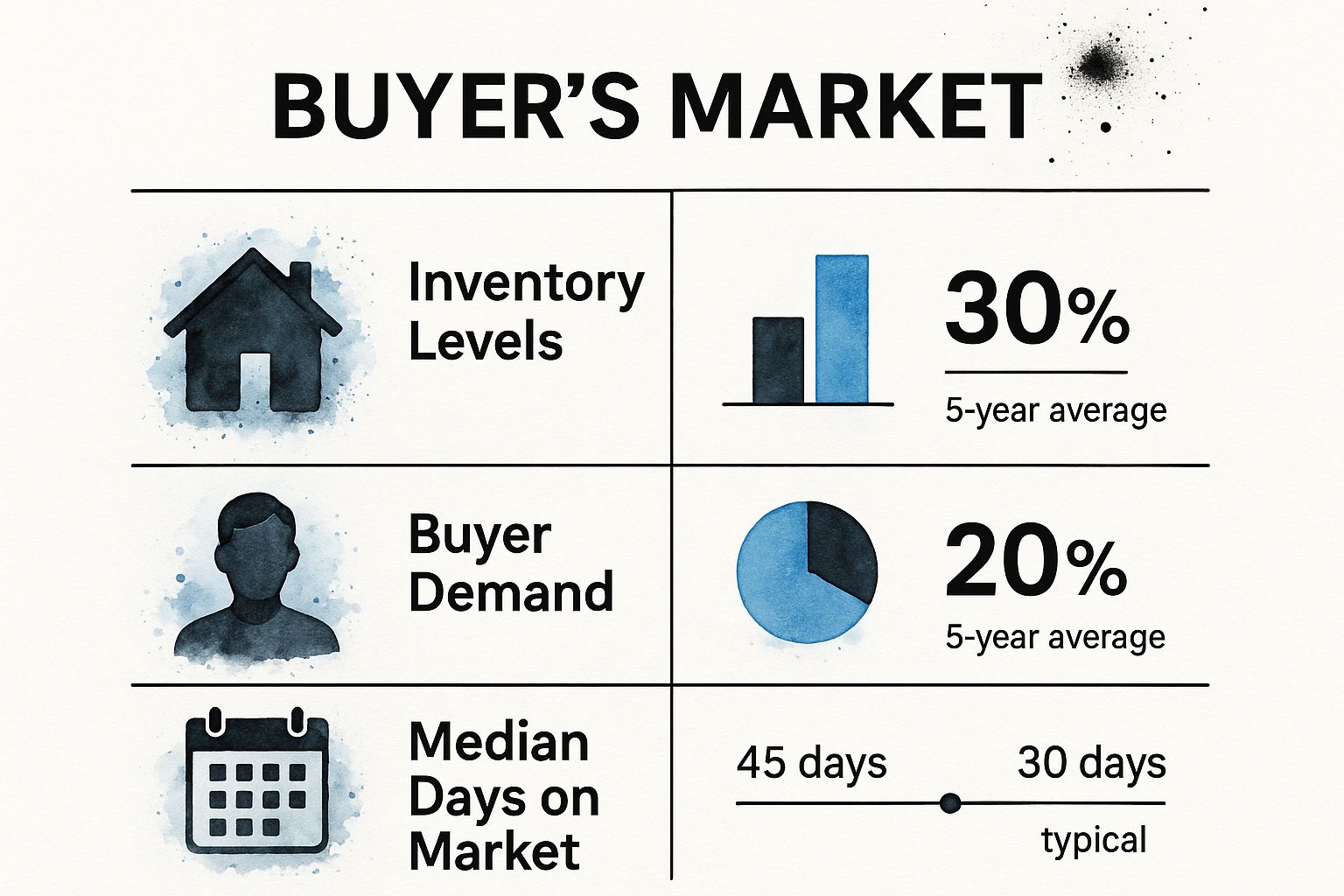
As you can see, a buyer’s market is a whole different world, one defined by more choices, less competition, and homes that sit on the market longer—giving you, the buyer, a serious advantage.
Buyer’s Market vs Seller’s Market Key Differences
The table below breaks down the fundamental differences between the two market types. Understanding these distinctions is crucial because your entire strategy—from how you search to how you negotiate—will change depending on who has the upper hand.
| Characteristic | Buyer’s Market | Seller’s Market |
|---|---|---|
| Negotiation Power | You’re in control. Lower offers and repair requests are expected. | The seller has the upper hand. Bidding wars are the norm. |
| Home Prices | Stable or even declining. You’ll see plenty of price reductions. | Rising fast. Homes frequently sell for more than the list price. |
| Pace of Sale | Slower. You have time to look at several properties and think. | Blazing fast. Homes can get snapped up in hours or a few days. |
| Seller Concessions | Common. Sellers might offer to pay for closing costs or repairs. | Rare. Buyers often have to cover more costs just to compete. |
This table makes it clear: when you’re in a buyer’s market, you have options and leverage that simply don’t exist when sellers are in charge.
The shift from a seller’s market to a buyer’s market forces everyone to completely change their game plan. Sellers start sweating their options on when to sell their house, while buyers suddenly find themselves in the driver’s seat.
It all comes down to supply and demand. A buyer’s market means there’s a surplus of homes, which puts direct downward pressure on prices. For example, when the number of sellers once outnumbered buyers by 34%—the biggest gap since 2013—annual home price growth tanked, slowing from 6.2% to just 1.6%. That’s the power of supply in action.
Your Playbook for Winning in a Buyer’s Market
Knowing what a buyer’s market is and actually using it to your advantage are two different things. It’s time to move past the theory and into the real-world tactics that turn good conditions into a great deal. This is your playbook for becoming a smart, strategic homebuyer.
First things first: patience is your superpower. In a seller’s market, you’re pressured into snap decisions. Here, you have the luxury of time—so use it. Find the right home, not just the first one that looks good. Don’t fall in love too fast; chances are another great opportunity is right around the corner.
Crafting a Killer Offer
With sellers competing for your attention, you’re in a position to make offers that might get dismissed in a hot market. Coming in below the asking price isn’t just possible; it’s often expected. The trick is to back it up with solid comps, which any good real estate agent can pull for you. For a deeper look, our guide on how to negotiate home price breaks down the entire process.
But a killer offer is about more than just the price. Think bigger.
- Seller-Paid Closing Costs: Asking the seller to cover some or all of your closing costs can save you thousands of dollars out-of-pocket. It’s a common and powerful move when you have the upper hand.
- Contingencies Are Your Best Friend: Forget waiving inspections to compete. In this market, you insist on inspection, financing, and appraisal contingencies. They’re your safety net.
- Repairs on Their Dime: The inspection report is your best bargaining chip. Make a list of necessary repairs and negotiate for the seller to either fix them before closing or give you a credit to handle it yourself.
Your real estate agent is your strategic partner in this game. They know how to spot a seller’s pain points—like a house that’s been sitting for 90+ days—and structure an offer that solves their problem while landing you a fantastic deal.
Part of a winning strategy is seeing the potential others miss. A home that needs some work can be a goldmine, and having some ideas for renovating an old house in your back pocket can be a game-changer. When you look past dated kitchens and ugly paint, you open up a whole new category of properties that other buyers overlook, giving you even more leverage.
The Economic Forces That Create Buyer’s Markets
Real estate markets don’t just flip on a dime. They’re driven by powerful economic currents that push and pull prices, inventory, and buyer confidence. If you learn to read these currents, you can see the next market shift coming instead of just getting caught in the storm.
Think about it like this: knowing the economic forecast gives you a massive head start.
One of the biggest levers is rising interest rates. When it costs more to borrow money, fewer people can afford a mortgage, plain and simple. That drop in demand cools the market down, leaving more homes sitting with fewer buyers—the classic recipe for a buyer’s market.
Shifting Supply and Demand
Economic jitters play a huge role, too. When the economy feels shaky, homeowners get nervous about selling. At the same time, builders with projects already in the pipeline keep pumping new homes onto the market. This can flood the market with inventory right when buyers start pulling back, tipping the scales even further in your favor. If you really want to get into the weeds, you need to do a thorough real estate market analysis.
Even what’s happening globally can ripple down to your neighborhood. Take international buyers, for instance. When foreign investment in U.S. real estate slows down—like when transactions recently hit a 15-year low—it pulls a significant number of buyers out of the game. That decline frees up inventory and creates more opportunities for local buyers to step in. You can dig deeper into these global property trends yourself.
A buyer’s market isn’t a random stroke of luck—it’s the predictable outcome of economic cycles. Higher interest rates, a jump in new construction, and even a drop in global investment all work together to create the perfect conditions for buyers.
Once you start watching these big-picture indicators, you’ll see that market shifts aren’t random at all. They’re part of a predictable cycle. This is the kind of insight that lets you build a strategy long before the “For Sale” signs start piling up on every corner.
Answering Your Lingering Questions
Even with a game plan, a few questions are probably still bouncing around in your head. Good. That means you’re thinking critically. Getting those final doubts ironed out is what separates a decent strategy from a winning one. Let’s tackle the big ones that always come up when the market starts tilting in the buyer’s favor.

Think of this as the final check-in, clearing up those “what-if” scenarios that can keep you up at night. This is where we put the last piece of the puzzle into place.
How Long Do Buyer’s Markets Typically Last?
This is the million-dollar question, and honestly, anyone who gives you a specific number is guessing. A buyer’s market might last a few months, or it could stretch out for a couple of years. Its lifespan is completely tied to bigger economic forces—things like interest rates, what the local job market is doing, and how fast new homes are being built.
The real takeaway here is that all markets are cyclical. Instead of trying to predict an end date, you and your agent should be watching the key indicators like inventory levels and days on market. Those numbers are your real-time dashboard, showing you exactly when the tide is starting to turn back toward sellers.
Is It Smart to Wait for a Buyer’s Market to Purchase a Home?
Trying to time the real estate market perfectly is a fantastic way to drive yourself crazy. Sure, a buyer’s market gives you more negotiating power on the price tag, but it often comes with a nasty side effect: higher interest rates. And that hits your monthly mortgage payment directly.
The right time to buy a house is when you are financially ready and you find a place that genuinely fits your life and long-term plans. Your personal readiness is a far more reliable guide than trying to outsmart complex economic cycles.
Can I Still Find a Good Home in a Seller’s Market?
Absolutely, but you have to play a different game. In a seller’s market, “winning” might not mean getting a deep discount. It might mean getting into a home you love without being dragged into a crazy bidding war or having to waive every single one of your protections.
Success in a seller’s market is all about being prepared to move fast and decisively.
- Get fully pre-approved, not just pre-qualified. It shows you’re serious.
- Come in with a strong first offer. Don’t lowball and hope for the best.
- Work with a top-notch agent who knows how to find off-market deals and navigate tough negotiations.
The pace is frantic and the competition is fierce, but with the right strategy and a professional agent on your side, you can always find a great home.
Navigating any market—buyer’s, seller’s, or somewhere in between—demands a real understanding of the local dynamics. At ACME Real Estate, we live and breathe this stuff. We bring the data-driven insights and strategic advice you need to make confident moves in Los Angeles. See what’s possible with us at https://www.acmexserhant.com.