
When your Closing Disclosure lands in your inbox, it’s a huge moment. You’re officially in the home stretch. But let’s be real, that five-page document can feel like a final exam packed with numbers and legal jargon. Don’t let it intimidate you. Think of it as your final financial battle plan—the last, best tool you have to make sure the loan you’re about to sign is exactly what you agreed to.
This isn’t just friendly advice; it’s your legal right. Your lender is required by law to get this document to you at least three business days before closing. That 72-hour window is your mandatory review period, a cooling-off phase designed to kill any last-minute surprises at the closing table. It’s your time to comb through the details, ask the tough questions, and be 100% certain before you sign on the dotted line.
Your Final Financial Checkpoint Before Closing
The Closing Disclosure, or CD, is the final, itemized bill for your home purchase. It’s a critical consumer protection tool created under the TILA-RESPA Integrated Disclosure (TRID) rule to bring transparency to the closing process. No more hidden fees or sudden changes.
The game plan is simple: put your Closing Disclosure side-by-side with the Loan Estimate (LE) you got at the very beginning. The LE was the lender’s educated guess. The CD is the final, locked-in reality. Some costs can change a little, but many are legally forbidden from increasing at all.
This comparison is your core strategy. It’s how you spot discrepancies and protect your wallet. This is your moment to verify everything:
- The final loan terms, interest rate, and monthly payment.
- Every single closing cost, from the appraisal fee to the title insurance.
- Your “cash to close”—the exact amount of money you need to bring to the closing.
The journey to this point was a marathon. Your loan application went through the wringer, a process you can learn more about in our guide to the mortgage underwriting process. Now, with the CD in hand, you have the final numbers. By the time you finish this guide, you’ll know exactly what you’re looking at and be ready to close with total confidence.
Loan Estimate vs Closing Disclosure Key Differences
Think of the Loan Estimate as the blueprint and the Closing Disclosure as the finished building. Here’s a quick comparison highlighting what changes between your initial estimate and the final numbers, so you know exactly where to focus your attention.
| Document Field | What the Loan Estimate Shows | What the Closing Disclosure Confirms |
|---|---|---|
| Interest Rate | The lender’s proposed interest rate, which could be locked or floating. | The final, locked-in interest rate for the life of your loan. |
| Closing Costs | Estimated third-party fees, taxes, and insurance premiums. | Actual, finalized costs from the title company, appraiser, etc. |
| Cash to Close | A good-faith estimate of the total funds you’ll need at closing. | The exact dollar amount you must bring to the closing table. |
| Prorations | An approximation of shared costs like property taxes or HOA dues. | The precise, calculated amounts based on your closing date. |
This side-by-side review is crucial. While some fees have zero tolerance for changes (like origination fees), others can increase by up to 10%. Knowing which is which is your secret weapon for a smooth closing.
Decoding Page One: Your Loan and Payment Summary
Alright, let’s dive into page one. Think of this as the high-level summary of your mortgage. Before you get lost in the weeds of line-item fees, this is where you confirm all the big-picture numbers are exactly what you agreed to. Nail this part, and the rest of the document will feel a lot less intimidating.
Your first stop should be the Loan Terms section. This is the absolute core of the deal—where the most important numbers live. You’re looking for three things here: your total loan amount, your interest rate, and your monthly principal and interest (P&I) payment.
Pro Tip: Don’t just glance at the interest rate. Make sure it’s the exact percentage you locked with your lender. Even a tiny fraction of a percentage point difference can cost you thousands over the life of the loan. If it’s not what you expected, stop right there and call your loan officer. Don’t wait.
Understanding Your Projected Payments
Now, let your eyes drift down to the Projected Payments table. This is where a lot of homebuyers get tripped up, but it’s really just a breakdown of your total monthly housing cost. It lays out your payment into what’s known as PITI.
- Principal & Interest (P&I): This is the basic mortgage payment you just confirmed in the section above.
- Mortgage Insurance: If your loan requires it, you’ll see that cost listed right here.
- Estimated Escrow (Taxes & Insurance): This is a big one. Your lender will collect a bit extra each month to cover your property taxes and homeowner’s insurance premiums. They hold it in an escrow account and pay those bills for you when they’re due. Just remember, this number is an estimate and can change from year to year.
This table gives you the full story of your monthly obligation. It’s not just about paying back the loan; it’s the all-in cost of owning the home. Getting a handle on these numbers is key for budgeting, and you can get a more detailed look into how to calculate mortgage payments to really master the math yourself.
Finally, we get to the showstopper at the bottom of the page: the Cash to Close amount. This is the exact dollar figure you need to bring to the closing table, usually as a cashier’s check or wire transfer.
It’s calculated by adding your closing costs and down payment, then subtracting any deposits or credits you’ve already paid. This number should be very close to what was on your initial Loan Estimate. If you see a big, unexpected jump, it’s time to pick up the phone and ask some serious questions.
Analyzing Pages Two and Three: The Nitty-Gritty of Closing Costs
Alright, this is where the real work begins. If page one was the movie trailer, pages two and three are the scene-by-scene breakdown of every single dollar changing hands. This is your chance to put on your detective hat. A sharp eye here can literally save you money, so don’t just skim it—dig in.
First up, you’ll see the Loan Costs table. This is the bill from your lender for creating your mortgage. You’ll find line items like origination charges, any points you paid to get a lower rate, and fees for services they managed, like the appraisal or credit report. Simple enough—these are the costs tied directly to the loan itself.
Then you’ll hit the Other Costs section. Think of this as the catch-all bucket for every other expense needed to seal the deal. This is where you’ll see things like title insurance fees, government recording charges for the new deed, and prepaid items like your first year of homeowner’s insurance or a chunk of property taxes.
Fee Tolerance: The Rules of the Game
Here’s the power move that every savvy homebuyer needs to know: you must compare these pages, line by line, to your original Loan Estimate. Lenders can’t just jack up fees whenever they feel like it. They have to play by strict rules, which are broken into three “tolerance” categories.
- Zero Tolerance: These fees cannot go up. Not by a penny. This includes the lender’s own origination fee and any transfer taxes. What they quoted is what you pay.
- 10% Cumulative Tolerance: This group covers third-party services, like title work and government recording charges. The total cost for all items in this bucket can’t increase by more than 10% from what was on your Loan Estimate.
- Unlimited Tolerance: Some costs can change without any limit. This isn’t as scary as it sounds. It applies to things like prepaid interest, your homeowner’s insurance premium, and the initial escrow deposit, mainly because they depend on timing or choices you make after the initial estimate.
Knowing these rules is your best defense against unexpected costs. It shifts you from being a passive signer to an active auditor of your own transaction.
I saw this happen just recently. A buyer was meticulously going through their documents and spotted a mysterious “$550 processing fee” that was nowhere to be found on their Loan Estimate. They pushed back and questioned it. The lender sheepishly admitted it was an error. Just like that, they saved over five hundred bucks simply by paying attention.
This infographic breaks down the core review process into three critical checkpoints for your Closing Disclosure.
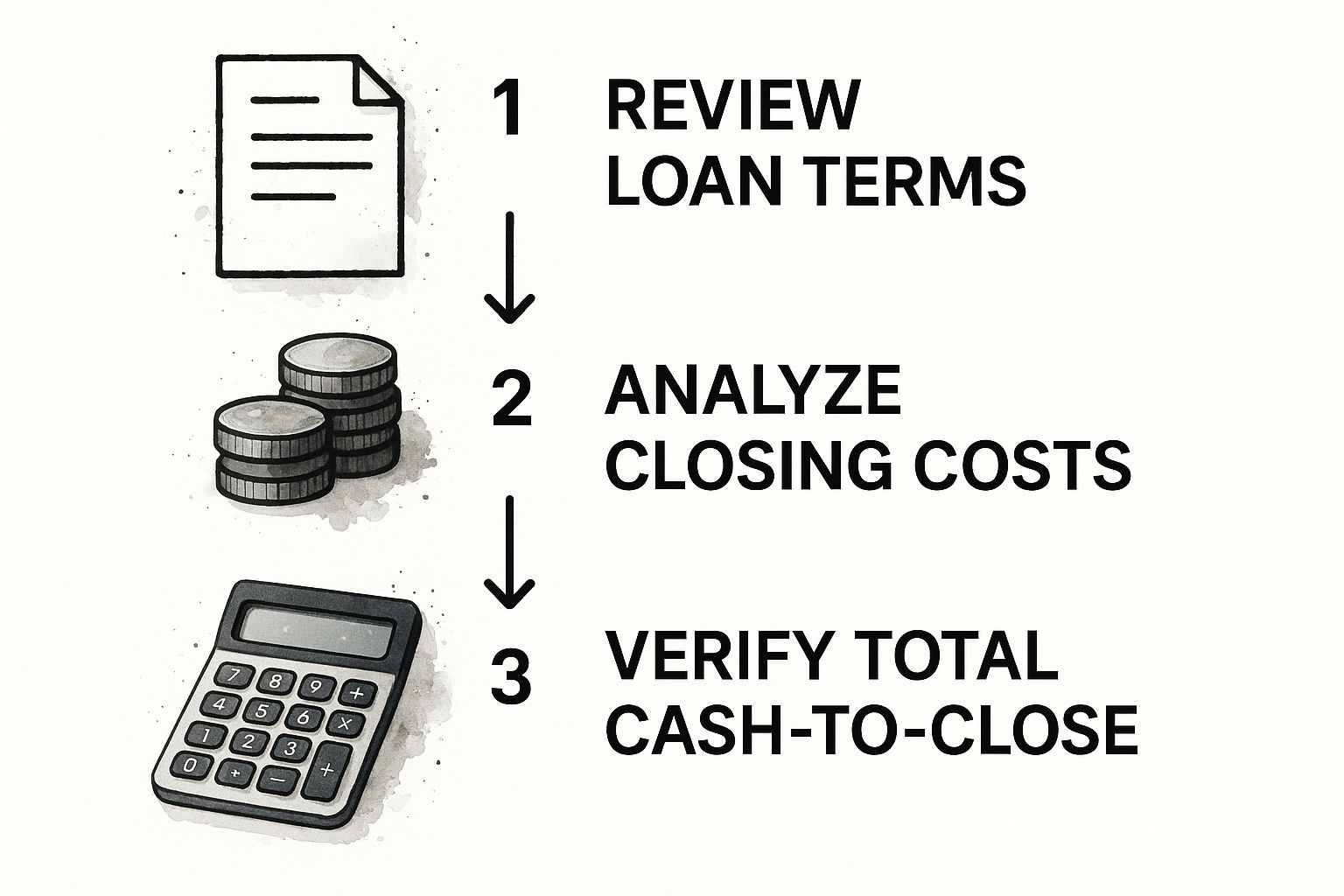
Tackle these steps in order. It ensures you confirm the big-picture loan terms before you get lost in the weeds of the cost analysis.
Spotting Errors and Saving Money
The potential for savings here is real. Nationally, closing costs usually land somewhere between $4,000 and $7,500. A careful comparison between your Closing Disclosure and the Loan Estimate can help you find savings of up to 10% on these costs. That could easily put hundreds, or even thousands, back in your pocket through simple questions or clarifications.
While you’re zeroed in on your side of the ledger, it can be helpful to understand what the seller is paying, too. Seeing the full picture often clarifies why certain fees are structured the way they are. You can get a sense of the other side of the transaction in our guide on typical home seller closing costs.
Ultimately, pages two and three tell the complete financial story of your home purchase. Take your time, use your Loan Estimate as your roadmap, and question every single fee that doesn’t feel right. This is your money, and you have every right to know exactly where it’s all going.
Page Four: The Rules You’ll Live By For The Next 30 Years

Alright, if pages two and three were all about the money it takes to get to the closing table, page four is about the long game. This is the fine print that will govern your life as a homeowner for the next 15 or 30 years. It can look like a wall of intimidating legal text, but don’t gloss over it. This is the contract you’re signing up for.
One of the first things you’ll spot is a simple checkbox for Assumption. This little box determines if someone else can take over your mortgage down the road. For the vast majority of conventional loans, this is a hard “no.” That means if you decide to sell the house, the loan has to be paid off in full. No passing the baton.
The Nitty-Gritty on Escrow and Late Fees
Next up, you’ll find the Late Payment terms. It’s pretty straightforward, but you absolutely need to know these numbers. It will tell you exactly when your payment is officially late—there’s usually a 15-day grace period—and what the penalty is. Expect to see a fee of around 5% of your principal and interest payment. It’s good to know the buffer is there, but obviously, the goal is to never use it.
Now, let’s talk about what I consider the most important section on this page: the Escrow Account details. This part spells out a few critical things:
- Confirmation of an escrow account: If you put less than 20% down, you almost certainly have one.
- What it pays for: You’ll see items like homeowner’s insurance and property taxes listed here. This account is where your lender stashes the money to pay those bills on your behalf.
- The reality of future changes: The form explicitly states your escrow payment can be adjusted. This is huge. When your property taxes inevitably go up or your insurance premium changes, your lender will recalculate what you need to pay each month. This is the number one reason people see their mortgage payment change over the years.
Understanding the long-term financial picture laid out in your Closing Disclosure is crucial. To get an even clearer view, it’s worth exploring the different rental property financing options that exist, as these choices fundamentally shape the loan terms you’ll be living with.
Finally, do a quick scan of this page for a section on Negative Amortization. Seeing this should be a massive, stop-everything-you’re-doing red flag.
Negative Amortization means your loan balance can actually go up even while you’re making monthly payments. This happens when your payment isn’t enough to cover all the interest that’s accrued. While these loans are rare these days, if you see the “YES” box checked, you need to slam on the brakes and demand an immediate, crystal-clear explanation from your lender. It’s a loan feature almost everyone should avoid.
Page four sets the terms of your financial life for decades. Getting comfortable with these obligations is a non-negotiable part of mastering your Closing Disclosure.
Reviewing Page Five: The Final Numbers and Signatures
You’ve made it. Page five is the home stretch of your Closing Disclosure review. Think of this page as the executive summary, cutting through all the line-item fees to show you the big picture of your new loan. It’s less about the small costs and more about the massive, long-term financial commitment you’re about to make.
The main event here is the Loan Calculations section. This is your 30,000-foot view of the mortgage. It shows the total amount you will have paid over the entire life of the loan if you make every single payment on time for 30 years. It can be a jaw-dropping number, but it’s a reality check you absolutely need to see.
APR vs. Interest Rate: What’s The Real Difference?
This is where things get interesting. The form lays out two critical numbers: the Annual Percentage Rate (APR) and the Total Interest Percentage (TIP). You’ve heard of APR, of course, but a lot of buyers are shocked to see it’s almost always higher than their interest rate.
Here’s the simple breakdown:
- Interest Rate: This is the pure cost of borrowing money. Nothing more.
- APR: This includes your interest rate plus a bunch of your closing costs and fees—things like origination fees and mortgage insurance.
The APR bundles in those extra costs, which is why it gives you a much truer sense of what you’re actually paying for the loan. When you were shopping around for mortgages, comparing the APR was the only real way to know which lender was genuinely cheaper.
Right next to it, you’ll find the Total Interest Percentage (TIP). This one is brutally honest. It tells you exactly how much interest you’ll pay over the entire loan term, shown as a percentage of what you borrowed. For example, a TIP of 85% on a $400,000 loan means you’ll pay a staggering $340,000 in pure interest over 30 years. It’s a stark reminder of just how much financing really costs.
The All-Important Signature Line
At the bottom of the page, you’ll see Contact Information for everyone involved: your lender, real estate agents, and the settlement company. Give this a quick scan to make sure it’s all correct.
Then comes the Confirm Receipt section, probably the most misunderstood part of this entire document. This is where you sign.
Crucial Takeaway: Signing this page does not mean you agree with the numbers or that you’re accepting the loan. It is simply a legal acknowledgment that you received the Closing Disclosure. That’s it. You are just confirming receipt.
If you find errors or have questions after you’ve signed, you still have every right to bring them up. Your signature just starts the clock on your mandatory three-day review period.
So before you put this page down, do one last check. Make sure you understand your APR and TIP, confirm the contact info is accurate, and most importantly, remember what that signature actually means. This final review ensures you walk into that closing room with a complete picture of your financial commitment.
Common Closing Disclosure Questions Answered

Even after you’ve combed through every line item, questions always bubble up in those final, high-stakes days before closing. It’s completely normal. This is a massive, complex transaction, and getting clarity on a few key points can turn that pre-closing anxiety into confidence.
Let’s tackle some of the most common questions I hear from homebuyers after they get their Closing Disclosure. Getting these answers locked down will help you handle any last-minute curveballs like a pro.
What Should I Do If I Find an Error?
First, don’t panic. The three-day review period is there for this exact reason. The second you spot something that looks off, call your loan officer and real estate agent. Point out the exact line item and show them how it differs from your original Loan Estimate.
Most of the time, it’s a simple typo or clerical mistake that gets fixed in a snap. But if it’s a major change—like a different interest rate, a surprise fee, or a prepayment penalty that wasn’t there before—it could trigger a whole new three-day review period. Acting fast is everything here; it’s the key to fixing the problem without blowing up your closing date.
Key Takeaway: Any unexpected jump in your loan costs needs to be questioned immediately. Your lender is legally required to justify any changes between what they estimated and what’s on the final Closing Disclosure.
Can My Cash to Close Amount Change?
Yes, and it’s something that catches a lot of people by surprise. Your final cash-to-close amount can shift slightly even after you have the CD in hand. Usually, this is because of last-minute prorations.
For example, final adjustments for property taxes, prepaid utility bills, or a credit the seller gives you after the final walkthrough can cause small fluctuations. These minor tweaks are a normal part of the process and won’t delay your closing.
Big swings are a different animal. If your loan terms, APR, or other major costs change, your lender has to issue a revised CD and restart that mandatory three-day review. The smart move? Call the title company or closing attorney the day before closing to get the final, final number. That way, your cashier’s check is for the exact amount, down to the penny.
Is the APR or the Interest Rate More Important?
This is the classic question. The truth is, they’re both crucial, but they tell you different parts of the story.
Think of it like this:
- The Interest Rate is simple. It’s the direct cost of borrowing the money.
- The APR (Annual Percentage Rate) is the big-picture number. It shows the true cost of the loan because it includes the interest rate plus other costs like origination fees, points, and mortgage insurance.
For that reason, the APR gives you a much better apples-to-apples comparison when you’re shopping for loans. It tells you which loan is genuinely cheaper over the long haul. Understanding this difference is one of the most important parts of learning how to read a closing disclosure and make a smart financial decision.
Navigating the wild world of real estate requires more than just knowledge—it takes a steady hand and real-world expertise. At ACME Real Estate, we’re in the trenches with our clients every single day, making sure you get to the closing table on your Los Angeles home with total clarity and confidence. https://www.acmexserhant.com